Beyond Flat Water : What 20 Miles Around Cape Ann Taught Two Rowers
At the Blackburn Challenge, two former collegiate rowers discovered that open-water racing demands more than fitness—and that the boat beneath you can fundamentally change how you experience the sea.
By Brent Keuch
About a mile into the Blackburn Challenge, Luke Briglin did the math.
“Okay,” he remembers thinking. “Only nineteen more of these.”
Ahead lay more than 20 miles of rowing around Cape Ann, Massachusetts. The course would take Briglin and fellow first-time competitor Silviu Tudor from the protected waters of Gloucester Harbor into the open Atlantic, around the cape, and back toward the finish at Pavilion Beach.
Often described as the Boston Marathon of open-water racing, the Blackburn Challenge attracts an eclectic fleet. Racing shells share the shoreline with coastal boats, surf skis, kayaks, canoes, and craft that resist easy classification. Some competitors come to win. Many return simply to test themselves against the distance, the conditions, and the coast.
For Briglin and Tudor, both members of the WinTech Racing team, the event was also an opportunity to compare two distinctly different approaches to open-water rowing.
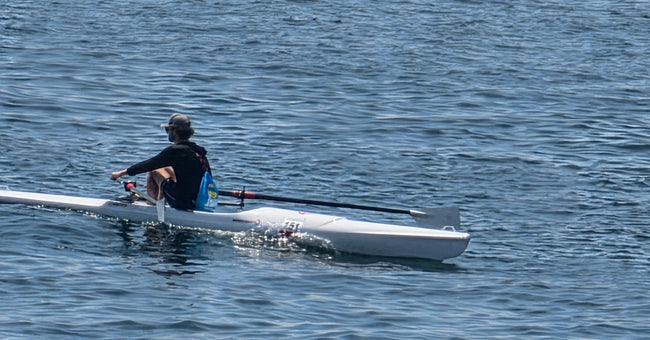
Tudor raced a traditional coastal single: wide, stable, and built to meet demanding offshore conditions. Briglin rowed WinTech’s new Wave Rider, a lighter, foot-steered boat designed to combine aspects of a rowing shell with the maneuverability and independent handling associated with surf skis and other open-water craft.
Neither man had raced Blackburn before. Both would finish with a new understanding of how different open-water rowing is from the controlled world of flat-water competition.
A Different Kind of Starting Line
The first surprise came before either boat touched the water.
Rather than the tightly controlled atmosphere of a traditional regatta, Blackburn felt to Briglin like a community gathering. Boats of nearly every description lined the beach as competitors helped one another prepare, traded advice, and swapped stories from previous races.
Many participants were experienced watermen and women rather than conventional racing specialists. The atmosphere was competitive, but it was also welcoming and practical. On a beach filled with unfamiliar equipment and first-time competitors, people readily offered an extra set of hands.
That communal spirit was reassuring, because the race itself allowed little room for complacency.
The opening miles followed relatively protected water, giving competitors time to settle into a rhythm before reaching the more exposed portion of the course. Once outside the harbor, however, the Atlantic introduced additional variables: crosswinds, rolling water, powerboat wakes, current, rocks, and the constant need to make navigation decisions.
A rower accustomed to a buoyed 2,000-meter course can focus almost entirely on rhythm and speed. At Blackburn, fitness was only one part of the equation. Every stroke had to be considered in relation to the water, the shoreline, and the remaining distance.
Two Boats, Two Experiences
Tudor, a former Division I rower at Syracuse University, chose WinTech’s traditional coastal single. Its width and 35-kilogram weight provided the stability expected from a boat designed for rougher conditions.
Briglin, who rowed at the University of Rhode Island, entered the Wave Rider. At approximately 25 kilograms, it was considerably easier for one person to handle ashore. Its shorter open-water hull and foot-controlled rudder were intended to make it responsive in waves without requiring the rower to interrupt the stroke for frequent steering corrections.
The difference was apparent before the race began and again after the finish. Tudor’s coastal boat benefited from two people carrying it across the beach. Briglin could lift the Wave Rider onto his shoulder and carry it himself.
That distinction may seem secondary during a 20-mile race, but it points to one of the practical barriers facing recreational open-water rowing. A boat can be exceptionally capable once launched and still be difficult for an individual rower to transport, rig, and move between a vehicle and the shoreline.
On the water, however, portability mattered less than the ability to respond to changing conditions.
Learning to Work With the Water
Briglin’s first impression of the Wave Rider was its familiarity. Although the boat looked and handled differently from a conventional shell, the rowing motion itself felt natural.
Then the water became more active.
At several points, large powerboats passed near the course, sending substantial wakes toward the competitors. Rather than waiting for each wake to reach him broadside, Briglin used the foot steering to turn the bow into the approaching water.
“I’d turn into a wave with the foot steering and ride it for a few strokes instead of fighting it,” he says. “Honestly, I was just having a blast.”
The steering quickly became instinctive. Small movements of the foot allowed Briglin to adjust his angle while maintaining his grip and rowing rhythm. Instead of treating every wave as an interruption, he began looking for ways to use the water.
That shift—from resisting the conditions to working with them—became one of the central lessons of the race.
For Tudor, the same wakes required a different response. His coastal single remained stable, but the combination of the boat’s width, the crosswind, and the passing traffic demanded frequent corrections. At times, he stopped rowing or adjusted his stroke to meet a wake more safely.
He also found that open water punished an overly aggressive catch. When the blades encountered irregular water, trying to force the stroke could disrupt the boat rather than accelerate it.
“I kept reminding myself to use shallow catches, avoid forcing the catch, push horizontally, and let the boat do most of the work,” Tudor says.
It was a technical adjustment, but also a mental one. Flat-water rowers are trained to impose consistency: repeat the stroke, hold the line, maintain the split. Open-water rowing requires a more flexible bargain with the environment.
When Twenty Miles Becomes Mental
Both rowers expected the Blackburn Challenge to be physically demanding. The psychological strain was harder to anticipate.
During the middle portion of the course, the finish remained too distant to provide much encouragement. Tudor focused on hydration, small amounts of food, the position of other racers, and the safest available line along the coast. As a first-time competitor, he watched more experienced racers and used their courses as navigation references while maintaining a safe distance from rocks and shore.
Briglin also resisted thinking too far ahead. Twenty miles is unforgiving of early enthusiasm, and both men concluded that pacing was one of the most important lessons they would carry into another long-distance event.
The basic preparations mattered as much as any sophisticated race strategy: a hydration system, sunscreen, a hat, appropriate nutrition, and enough time in the boat beforehand to refine the foot-stretcher and seating positions. A small discomfort at the start can become a serious problem after several hours.
The race’s second half eventually brought more favorable conditions. After rounding Cape Ann, the crosswind gradually became a following wind. The current, waves, and direction of travel began to align.
“It was perfect,” Briglin says. “The wind, the waves, and even the current all started working with you.”
Near the end, the large jetty before the finish created a deceptive milestone. In a conventional race, the sight of the final landmark might signal a 500-meter sprint. At Blackburn, it still left approximately two miles to row.
Both men kept moving.
A Broader Definition of Rowing
Neither Briglin nor Tudor finished the day talking first about a time or placing. They talked about completing the course, learning to read the water, and discovering a community that approaches competition differently.
They also came away with a more nuanced understanding of boat design.
The traditional coastal single offered the security and robust construction expected of an established offshore format. The Wave Rider offered a different proposition: reduced weight, responsive steering, and an experience that encouraged the rower to engage with waves rather than merely withstand them.
It is not a question of one design replacing the other. The more interesting question is whether a wider range of boats can create more ways for people to enter the sport.
Coastal rowing and Beach Sprint Rowing are attracting growing international attention, but the appeal of open water extends beyond formal competition. For conventional rowers, it offers exploration, changing conditions, longer journeys, and a freedom rarely found between buoy lines. For newcomers, a stable and manageable boat may make rowing accessible in places where protected flat water is unavailable.
At Blackburn, Briglin and Tudor found that the essential rowing motion remained familiar. Almost everything surrounding it had changed.
The course demanded patience instead of a sprint, navigation instead of a fixed lane, adaptation instead of repetition, and respect for conditions that no athlete could control.
Both have already committed to returning.
Next time, Tudor wants to break three hours. Briglin is considering whether to race a single or double—and whether someone else should be given the chance to beat his Wave Rider time.
After more than 20 miles around Cape Ann, the challenge no longer seems unfamiliar.
It simply feels unfinished.